Corporate, B2B, and service websites
Capabilities, industries, credibility, processes, specialised services, qualification, booking, proof, and enquiry pathways.
Growthut plans websites around what users and internal teams must understand, trust, and accomplish. The result may be a focused service website, a commerce experience, or a separately scoped digital platform.
It may need to explain an offer, establish credibility, generate enquiries, sell products, onboard customers, deliver learning, manage accounts, automate workflows, integrate sales information, support international markets, provide customer service, or create measurable user journeys.
The correct website depends on what the business needs users and internal teams to accomplish.
Business users move between phones, tablets, laptops, and desktops. They expect clarity, speed, privacy, accessibility, and reliable actions. Internal teams also need manageable content, accurate data, and defined responsibility after launch.
Priorities should be agreed before design and validated before launch.
The categories below are capabilities that can be assessed, not a promise that every feature belongs in one basic website package.
Capabilities, industries, credibility, processes, specialised services, qualification, booking, proof, and enquiry pathways.
Product discovery, filtering, checkout, payment gateways, inventory, shipping, order communication, and post-purchase journeys.
One campaign, offer, audience, or conversion objective with message continuity and measurable actions.
Registration, subscriptions, role-based access, dashboards, billing, usage monitoring, notifications, data handling, and support workflows.
Lead capture, records, sales stages, task assignment, reminders, notes, history, reporting, permissions, and marketing integrations.
Course creation, lessons, quizzes, assessments, progress, certificates, student and instructor accounts, payments, support, and reporting.
Separately scoped client, vendor, employee, distributor, member, and partner access with appropriate permissions and workflows.
Availability, time slots, staff assignment, payments, reminders, cancellation rules, and calendar integrations.
Seller onboarding, listings, search, payments, commissions, reviews, disputes, order management, and moderation.
Scalable content management and role-based editing, with editable areas and responsibilities agreed during planning.
Integration requirements, data flow, error handling, security, ownership, third-party costs, and testing defined separately.
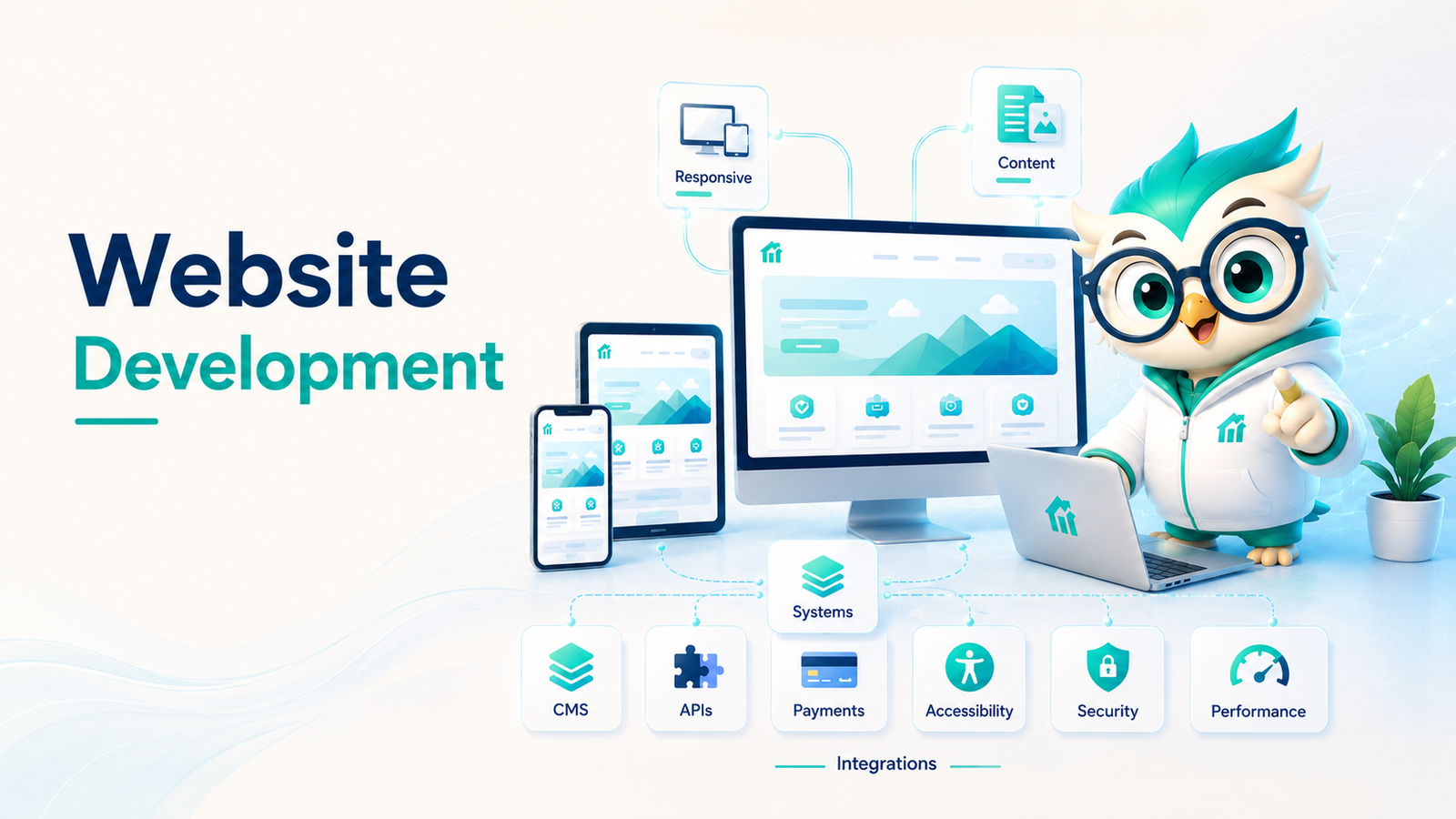
Mobile responsiveness, accessibility, security, performance, analytics, SEO foundations, launch checks, and an agreed maintenance model.
Clarify outcomes, constraints, ownership, and priorities.
Understand users and internal stakeholders.
Document features, responsibilities, and boundaries.
Organise pages, content, and relationships.
Plan key journeys and system states.
Assign information to each decision point.
Validate structure before visual detail.
Create an appropriate, consistent interface language.
Build reusable patterns for future consistency.
Implement the approved interface and functionality.
Connect content and agreed third-party systems.
Test devices, widths, and orientations.
Validate keyboard, semantics, labels, and contrast.
Control loading, layout shifts, and asset weight.
Prepare technical foundations and measurement.
Review forms, access, data, and deployment.
Confirm content, functionality, and responsibilities.
Release with checks and transition planning.
Support agreed fixes, updates, and improvement.
Possible functions include guided search, knowledge-based assistance, content recommendations, form assistance, lead qualification, internal workflow automation, document summarisation, support triage, and personalised onboarding.
These functions are scoped separately according to data, model, integration, privacy, reliability, and operating costs. They are not added merely because an AI feature appears modern.
May ask the client to select a template and send content. Design choices then lead the project before the user journey and operational requirements are understood.
First establishes what users should understand, trust, and do. Design, content, development, integrations, testing, and ownership then support those outcomes.
A consulting firm receives a polished website with animated sections and generic copy. Visitors admire the design but struggle to understand the difference between services or which action to take.
Growthut maps the firm's buyer types, decision stages, objections, proof requirements, and enquiry process. The site is then structured to clarify the offer, qualify visitors, establish confidence, and support future content.
Measures depend on whether the website is intended to explain, generate enquiries, sell, onboard, deliver learning, manage accounts, or support another workflow. Growthut reports available evidence without inventing an uplift.
No. Projects may include corporate websites, e-commerce systems, landing pages, LMS platforms, CRM systems, SaaS products, portals, booking platforms, and custom applications.
The initial build is normally a one-time project. Hosting, maintenance, security, support, content updates, and continued development may be charged separately after the included support period.
Yes. Responsive behaviour should be planned and tested across mobile phones, tablets, laptops, desktops, screen orientations, and common browser conditions.
Where appropriate, Growthut can provide a CMS and role-based editing access. Editable areas should be agreed during planning.
Technical search foundations can be included, such as semantic structure, metadata capability, sitemap generation, responsive design, and performance preparation. Ongoing SEO strategy and content development remain separate services.
Is your website helping users make a confident business decision, or simply giving them something attractive to scroll through?
Share the users, journeys, content, integrations, and internal workflows involved. Growthut can assess the appropriate type and complexity of build.